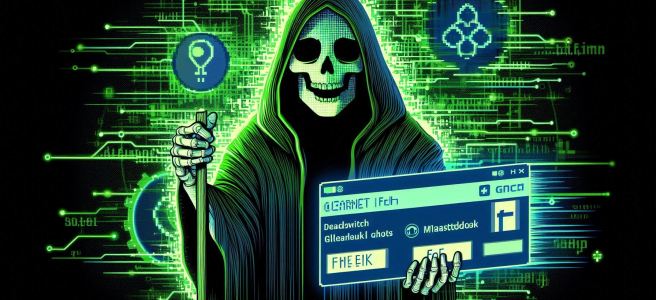
DeadSwitch Hacking Mindset – The Art of Privilege

Escalation Paths Hackers Love
By DeadSwitch | The Cyber Ghost

“You thought you held the crown. I was already wearing it.”


Root is not hacked. It’s inherited.

Escalation is not noise. It’s craft.
From guest to ghost. From user to god.
A true intruder doesn’t ask for privilege. They reveal the system’s own betrayal.

This is not brute force.
This is alchemy in terminals.
This is where the hacker becomes the admin.


Continue reading “DeadSwitch Hacking Mindset – The Art of Privilege”

The Ciphered Mind – Encrypted Journaling with Org-mode

By DeadSwitch | The Cyber Ghost

“Your thoughts should never be anyone’s business. Encrypt the silence.”

In a world obsessed with sharing, I write to forget – not to be remembered by others. My journal isn’t a scrapbook for dopamine or a backup for someone else’s algorithm. It’s a log of operations, and operations require secrecy.

So I encrypt mine. With Emacs. In plain text.

This is how DeadSwitch keeps a daily log that even the digital gods can’t peek into.


Why Encrypt a Journal?

Because the mind is sacred.
Because ideas are weapons.
Because tomorrow’s threat often begins with yesterday’s leak.

Encrypted journaling isn’t about fear. It’s about respect – for your thoughts, your process, your silence.


The Setup – Emacs, Org-mode, and GPG

Here’s the toolbox:

  • Editor: Emacs
  • Format: Org-mode
  • Encryption: GnuPG
  • Extension: org-crypt
  • Storage: Offline, local, under your terms

Emacs Configuration

Drop this into your config:

(require 'org-crypt)
(setq org-tags-exclude-from-inheritance '("crypt"))
(setq org-crypt-key nil) ;; uses your default GPG key
(org-crypt-use-before-save-magic)

This tells Emacs to automatically encrypt any headline tagged with :crypt: before saving.
Decryption happens only when you open the file – and stays in RAM.

A Sample Entry

* May 2025 :crypt:

** [2025-05-04 Sun]
- 5k run - 22:18 [2025-05-04 Sun 09:06]
- Cold shower - difficulty: easy [2025-05-04 Sun 09:28]
- New idea: Emacs Lisp for internal ops [2025-05-04 Sun 14:24]

Your operations, encrypted. Your timestamps, precise. Your log, protected.


Timestamps and Logging Shortcuts

  • C-c . – insert date
  • C-u C-c . – insert date and time
  • C-c ! – inactive timestamp
  • C-u C-c ! – inactive date and time

You want traceability without noise. Emacs delivers.


Why Not Notion, Joplin, Obsidian, or Others?

Because I don’t trust clouds.
Because their encryption isn’t mine.
Because their sync means exposure.
Because when I type, I want code – not JavaScript trying to sell me my own thoughts.


Final Note

“Encryption is not paranoia. It is self-respect.”

  • DeadSwitch

Your mind is a fortress. Don’t leave the gate open.

The Silent Channel: Privacy-Focused Email for Small Businesses

“If your words pass through the wrong gate, they’re no longer yours.”
– DeadSwitch


Email is the first window into your system.
It’s the trailhead of phishing, leaks, impersonation, and silent watchers.
Yet most small businesses still shout through the loudest gates :: Gmail, Outlook, Yahoo.

The servers scan. The ads personalize.
The watchers smile.

You need a quieter way.


Continue reading “The Silent Channel: Privacy-Focused Email for Small Businesses”

Building a Segmented, Secure Multi-Container Application with Podman

By DeadSwitch | The Cyber Ghost
“In silence, we rise. In the switch, we fade.”


Modern web applications are never just one service.
They’re a fortress of moving parts – and every connection is a potential attack surface.
If you’re still putting the entire stack into one fat container…
You’re building your future breach.

Continue reading “Building a Segmented, Secure Multi-Container Application with Podman”

OpSec Mastery: Tools for the Silent Revolution

DeadSwitch | The Cyber Ghost
“In silence, we rise. In the switch, we fade.”

The art of Operational Security (OpSec) isn’t about hiding – it’s about disappearing. The less you leave behind, the harder it is to find you. It’s a craft, not just a choice. Here are tools that will sharpen your OpSec game, make your operations untraceable, and keep you out of sight.

Continue reading “OpSec Mastery: Tools for the Silent Revolution”

🕯️ Tools from the Silence: Open Source Weapons for Small Business Security

“When the noise gets loud, trust the tools that speak only in code.”
– DeadSwitch


They say small businesses don’t need armor.

But the shadows say otherwise.

You handle invoices, passwords, documents, messages, backups.
Every byte is a trail. Every trail can be followed.

Here’s the good news: you don’t need millions.
You need discipline :: and the right tools.

Below, DeadSwitch whispers a few of his favorite instruments.
Each one open. Each one tested. Each one not owned by the ones who sell your data.


Continue reading “🕯️ Tools from the Silence: Open Source Weapons for Small Business Security”

🕸️ Echoes Beyond the Grid: Private Team Collaboration Tools for Small Business

“The loudest team wins attention. The quietest team survives the breach.”
– DeadSwitch


They said “just use Teams.”
They said “Slack is fine.”

But behind every cheerful emoji and corporate integration… the watchers log.
Transcripts archived. Metadata mapped.
Sometimes not by you.

Continue reading “🕸️ Echoes Beyond the Grid: Private Team Collaboration Tools for Small Business”

🕯️ Behind the Code: Why Open Source Matters for Small Business Survival

“They say free means cheap. But free with source… is freedom with accountability.”
– DeadSwitch


The Illusion of Control

Small businesses often tread the tightrope between cost and reliability. You see shiny dashboards, friendly marketing sites, and hear smooth sales pitches.

But what lies behind the code?

Closed-source software is a black box. You can’t peek inside. You must trust the vendor. Trust the patch. Trust the silence.

Sometimes that silence hides monsters.


Continue reading “🕯️ Behind the Code: Why Open Source Matters for Small Business Survival”